Sep 2023 - Present (Even in 2026!)
Simon Fraser University Community Engagement Award Winner 2023-2024
One Tap Away Chatbot:
AI Agent to Provide Resources Against Gender-Based Violence
Jae Eun
E
Ella
K
Kate
V
Valeriya
AI Design
Service Design
UX Research
Usability Study
Social Innovation
One Tap Away is an ongoing social innovation project to build a chatbot that provides information about organizations that provide support against gender-based violence. This is a self-led project, partnered with VLMFSS (Vancouver Lower Mainland Multicultural Family Support Services), a local charity combats gender-based violence (GBV), funded by SFU Community Engagement Award.
Hugging Face
Figma
Botpress
Make
Google Sheets
How did this project start?
Back in summer 2023, I worked at VLMFSS as a Community-Based Victim Support Worker. I recognized that young individuals who lack a strong support network are faced with a vast amount of information available online to navigate, contact, and verify by themselves.

Additionally, when I was doing follow-up calls, I sensed that young clients in their early 20s are more hesitant to talk on the phone than older clients.
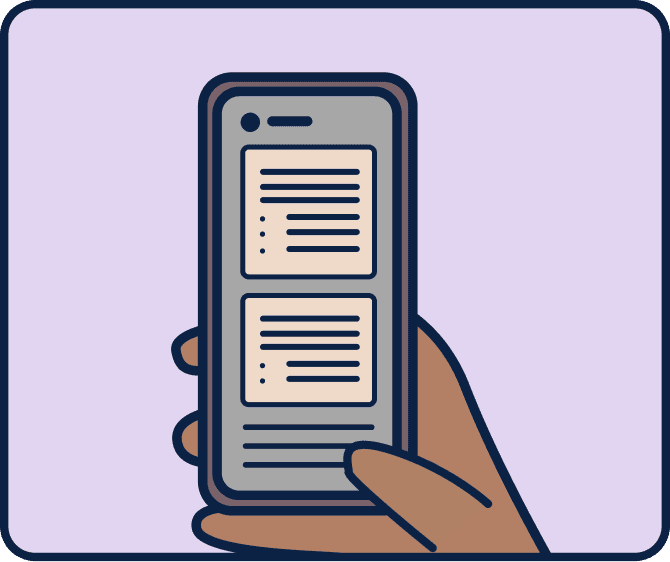
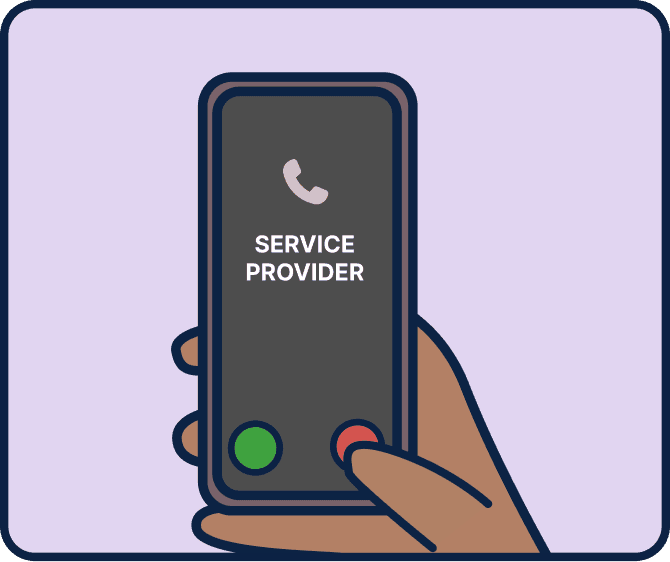
I wondered, can there be any other mode of contact augmented by technology that replaces traditional yet daunting contact methods like a phone call?
One Tap Away Chatbot: An AI-powered chatbot that provides gender-based violence support resources in a digestible way.
Chatbot presents community resources in an accordion, catered to the user concern.
AI summarizes the content in a way that is relevant to the user concern.
Chatbot offers AI-powered answers to the user's follow-up questions.
Directed Studies gave me inspiration.
Around this time was when I was inspired to make a chatbot through my Directed Studies in fall 2023 at SFU SIAT.
This is a video of a concept I developed at the end of the Directed Studies, visualizing how the chatbot acting as the first point of contact would look like.
The main finding out of this research was that 64% of survey respondents (39/61) thought a chatbot could improve SFU Counselling Services, albeit for administrative capacity, such as for navigating websites or booking appointments.
This finding that young individuals thought favourably about chatbots prompted me to do a project to build a chatbot that could become the first point of contact in the face of gender-based violence.
What is the Problem Space?
Before I launch on the project, I wanted to discover what are some existing problems with traditional modes of contact that the chatbot could replace.
2021 Consumer Experience Trends Healthcare Report
72%
of Millennials and Gen Z prefer online doctor appointments.
60%+
of these age groups reported using smarphones or tablets to research healthcare providers.
2023 KPMG survey
58%
of Millennials highly values online appointment and would switch providers for this convenience.
64%
of Gen Z highly values online appointment and would switch providers for this convenience.
Project Rationale
How can we tailor the experience of providing resources for young individuals, given that they are more comfortable with technology-intervened interaction with the service providers?
Design Scope
Technology being tested is a chatbot, in which the system produces text messages based on the user's input.
The chatbot would be used for providing resources about gender-based violence support services in the community.
The project was awarded $2000 through SFU 2023-2024 Student-Community Engagement Competition!
I gathered up two more undergraduate students, then applied for SFU 2023-2024 Student-Community Engagement Competition for the project to integrate chatbot into VLMFSS' system ; then called the project 'One Tap Away' chatbot. We secured $2000 funding through the Competition!

Above is the video that we created after the competition; the video shows how the very initial prototype functioned.
I tested the idea through Participatory Co-Creation Workshop.
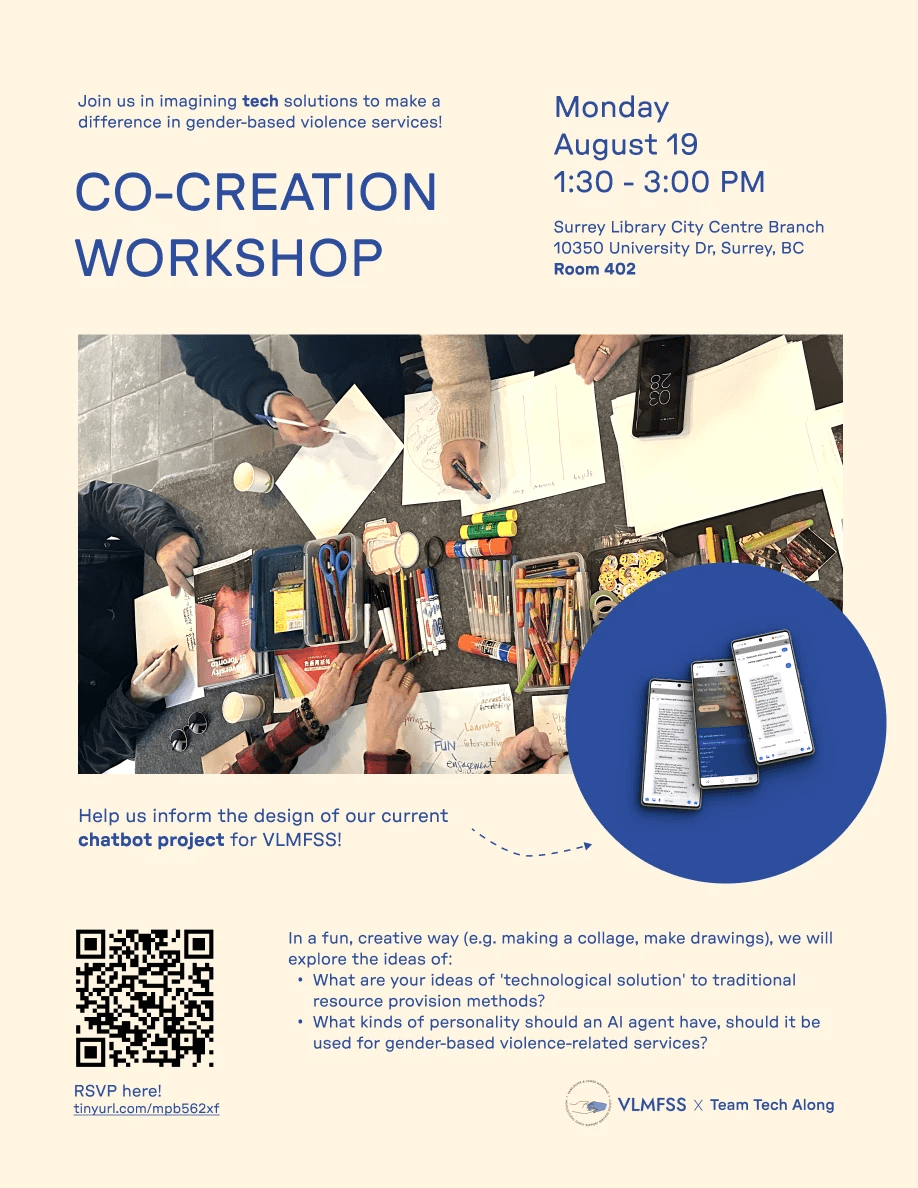
Would the chatbot idea work?
Before I launch on the project, I wanted to discover what are some existing problems with traditional modes of contact that the chatbot could replace.
Participants
3 service providers from VLMFSS who have direct experiences working with young clients.
Professor Yalcin with experrtise in modelling socio-emotional behaviours for digital interactive agents.
Workshop Goals
To explore and gather qualitative, observational data on the potential users’ perception of a chatbot.
To unearth opportunities in designing functionality and personality of the chatbot.
To find out to what degree the participants would find the chatbot effective and beneficial.
What were the questions asked?
Prompts Given
What are your ideas of 'technological solution' to traditional resource provision methods?
What kinds of personality should an AI agent have, should it be used for gender-based violence-related services?
What were the insights?
Click the arrow in the panel below to discover the insights learned from the workshop.
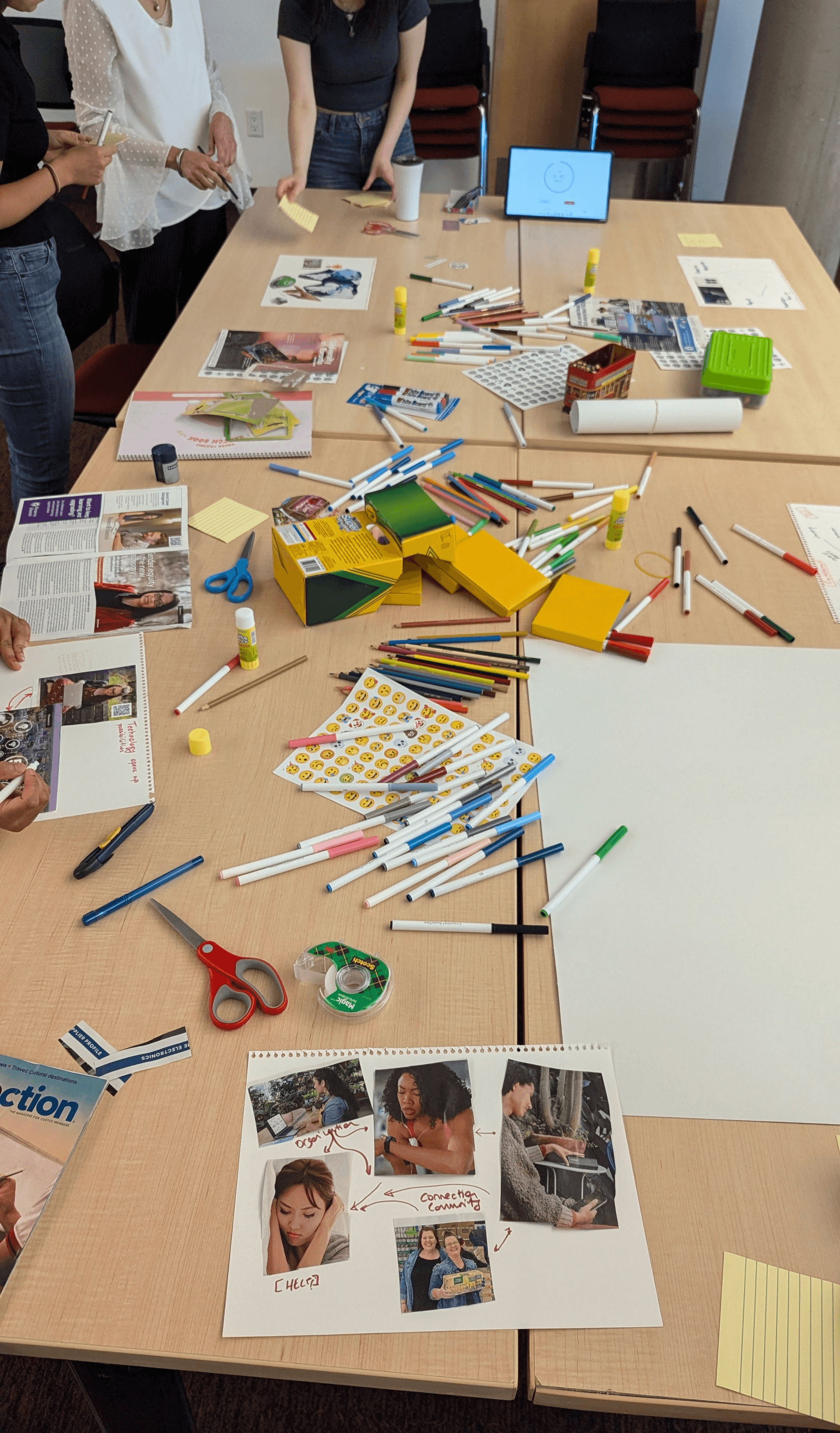
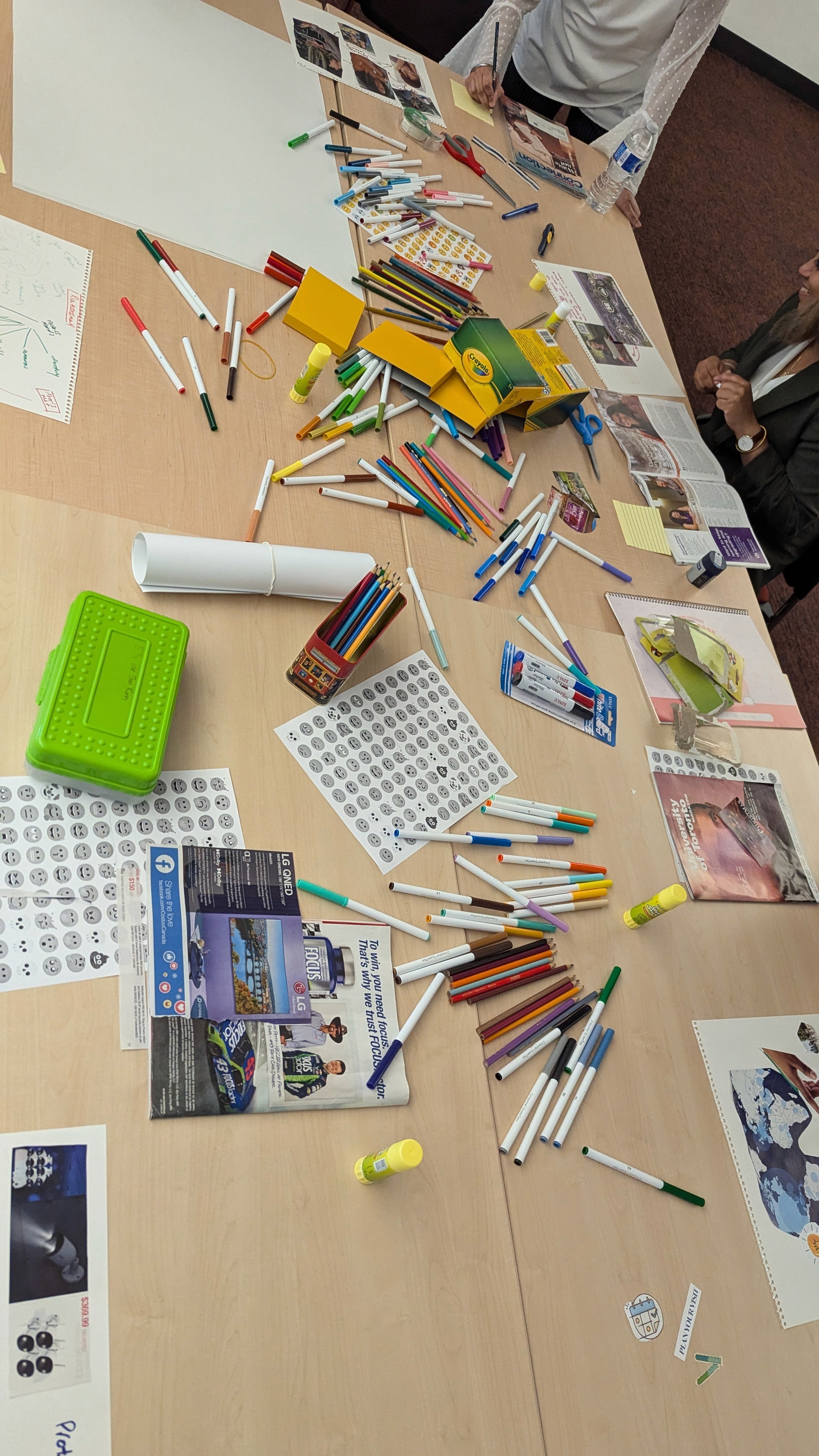
The participants were asked to draw their responses.
How did it lead to making an AI chatbot?
This workshop's outcome motivated me to integrate AI to the chatbot. Below summarizes the workshop key points that led me to such a decision.
Key Insights
When asked about the kind of personality a chatbot agent should have for gender-based violence-related services, the participants noted the ability to take on different forms, dependent on the users’ needs.
Unearthed Design Opportunity!
Creation of an AI chatbot, potentially with the ability to dynamically change its content upon expressed user needs.
I created working prototype with a no-code AI tool.
Based on the insights from participatory design workshop, I created a working prototype using a no-code AI chatbot tool, Voiceflow. This enabled typing input to activate generative AI-powered responses, which searches from a PDF list of resources.

In addition to chat buttons, Voiceflow enabled typing input option to activate generative AI responses.
I envisoned the use case of the chatbot with a user journey map.
I created a user journey map to identify what the ideal outcome of the interaction would be. Upon creating the map, I had a clear idea that the interaction would conclude with resource provision, which consists of: contact information of relevant service providers, and brief service description.
Discovery
Action
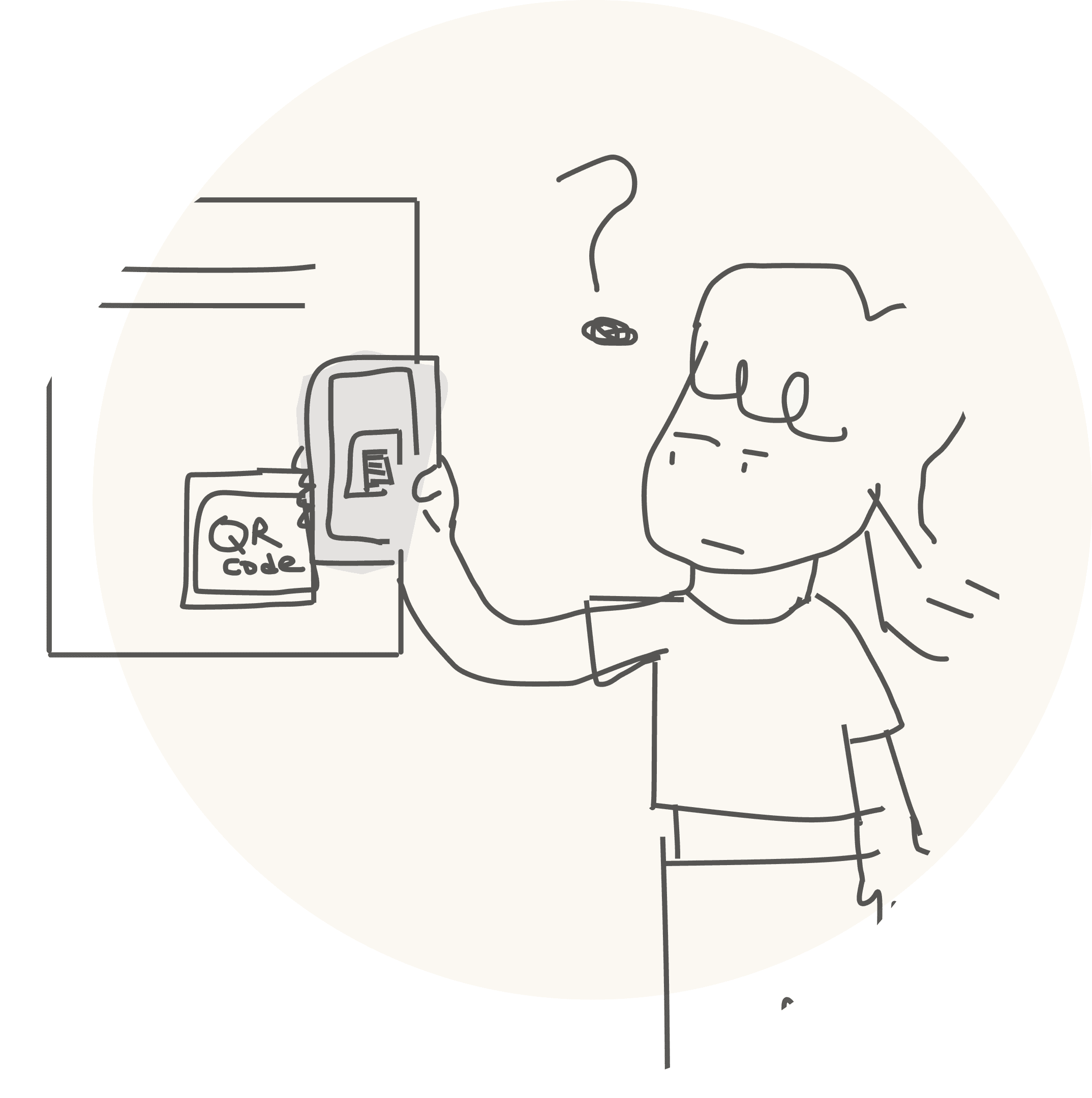
Comes across a poster that contains information about the chatbot on school campus.
Reads the step-by-step guideline on a poster.
Scans QR code on the poster upon deciding to engage with the website.
Question
I wonder what this poster is saying?
Is this another school service? Is this coming from any legitimate source?
Is this free resource?
Emotion
[curious] I wonder what this poster is saying.
[confident] Seems like it’s just a chatbot and I am familiar with using it.
Goal
Discovery of new service available on campus.
Pain Point
Uncertainty of what to expect
Design Opportunity
An NFC chip embedded on a poster instead of a QR code to allow for more smoother entry point and lower barrier to the service.
Poster that has clear yet brief step-by-step guide of how to use the website to allow setting clear expectations for the user.
I conducted usability study with a Case Manager at SFU Sexual Violence Support & Prevention Office then updated the prototype.
Research Question
What are the service providers’ mental model and perceived risk for a conversational chatbot agent, providing gender-based violence related resources?
Here is overview of the research methodology.
Pre-Study Questionnaire
Asked demographics questions
Current occupation & expertise
Familiarity with interactive agent, gender-based violence
Discovery Questions
Inquired about to what degree the participant perceived usefulness of the chatbot.
Usability Study Tasks
Provided a set of tasks based on given prompts, while thinking aloud.
Looked for verbal and emotional expression of frustration and identified pain points accordingly.
Post-study Interview Questions
Asked for general feedback for improvement and potential risks.
Could you please provide us general feedback about how we can improve this chatbot?
Could you please tell us about any potential risks or concerns about this chatbot?
Severity Assignment
Referred to Nielsen’s (1994) Severity Ratings for Usability Problems to identify issues and estimate the need for revision, before releasing the final prototype to VLMFSS.
Nielsen, J. (1994, November 1). Severity ratings for usability problems. Nielsen Norman Group. https://www.nngroup.com/articles/how-to-rate-the-severity-of-usability-problems/
What was the biggest takeaway?
One of the major usability problems was that the speed and amount of information flow was overwhelming and desensitizing. Below, I broke down the usability problem severity rating.
Noted Remarks from the Participant
"That's going so quick…It's screaming information…I am overwhelmed."
Frequency
How frequent is the issue?
Not an issue
Rare
Somewhat frequent
Very frequent
"Screaming information" by providing a lengthy list of resources happened every user request.
What changes I made to the prototype?
Utilizing another no-code chatbot tool Botpress, I simplified and reduced the amount of information by automatically re-formatting the list of resources. Specifically, I used Botpress and an automation tool Make to create an accordion of resources, replacing a text-based list. In this way, I significantly reduced the users' cognitive load when finding relevant information.
Tools Used
Botpress
Google Sheets API
Make
Updates
Users can access an HTML file listing resources relevant to their concerns and location. Each panel includes the organization’s name and category labels, condensing the amount of information presented at first glance.
Major challenge arose from privacy issues.
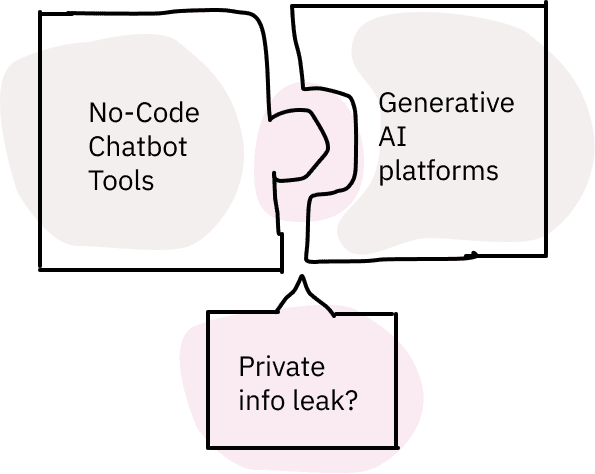
VLMFSS Director and IT representative raised concern that that the AI chatbot was always at risk of data breaches or leaks. In the case of API integrations, it was unclear about what information is exchanged with external AI platforms.
What kinds of potential scenarios raised the alarm?
Clients may share sensitive information.
No-code chatbot tool platform and its APIs stores entire chat history.
If data is leaked, it could be accessed by unintended audience, such as violence perpetrators.
Why does this matter to me, as a designer?
Privacy issues meant that it would be extremely difficult for me to identify the mechanisms behind how the chatbot content is processed.
I asked myself, how might I keep the balance between the benefits of AI in personalizing chats and its privacy risks?
What decisions did this issue lead to?
I decided to focus on simpler version of a chatbot, this time code-based, so that I could have more understanding of its mechanism. Since I would be the administrator of the chatbot, I expected that I would have the control over its chat history, which would resolve privacy concerns.
I created a code-based AI chatbot!
In winter 2025, as part of SFU SIAT course Exploring Artificial Intelligence: Its Use, Concepts, and Impact, I had the opportunity to continue One Tap Away project to realize the idea of integrating code-based AI. I paired up with Valeriya to complete the integration.
What kind of AI chatbot is it?
With Valeriya, we created a real-time Retrieval-Augmented Generation-based (RAG) chatbot that utilizes a lightweight, open model large language model Gemma, provided by Google.
How does RAG work?
RAG enables Gemma to extend its knowledge in addition to its trained data, then retrieve information from the knowledge source contextualized for specific use cases.
What is this project's knowledge source?
As this project’s knowledge source, we used a spreadsheet of Metro Vancouver GBV support service organizations, carefully curated by myself throughout my work and volunteer experiences.
How does the LLM-based chatbot work?
Click the arrow in the panel below to learn about how the chatbot currently works!
LLM imports data from the spreadsheet (i.e. RAG knowledge base), stores it as dataframe.
The chatbot is deployed on Hugging Face for anyone to test out!
What is the current stage of the chatbot?
The chatbot created with Botpress is currently featured in VLMFSS website!
After hearing about the privacy concerns, I reconsidered how the chatbot’s behaviour should align with VLMFSS’s priorities. At this stage, I chose to remove AI capabilities from the Botpress version of the chatbot.
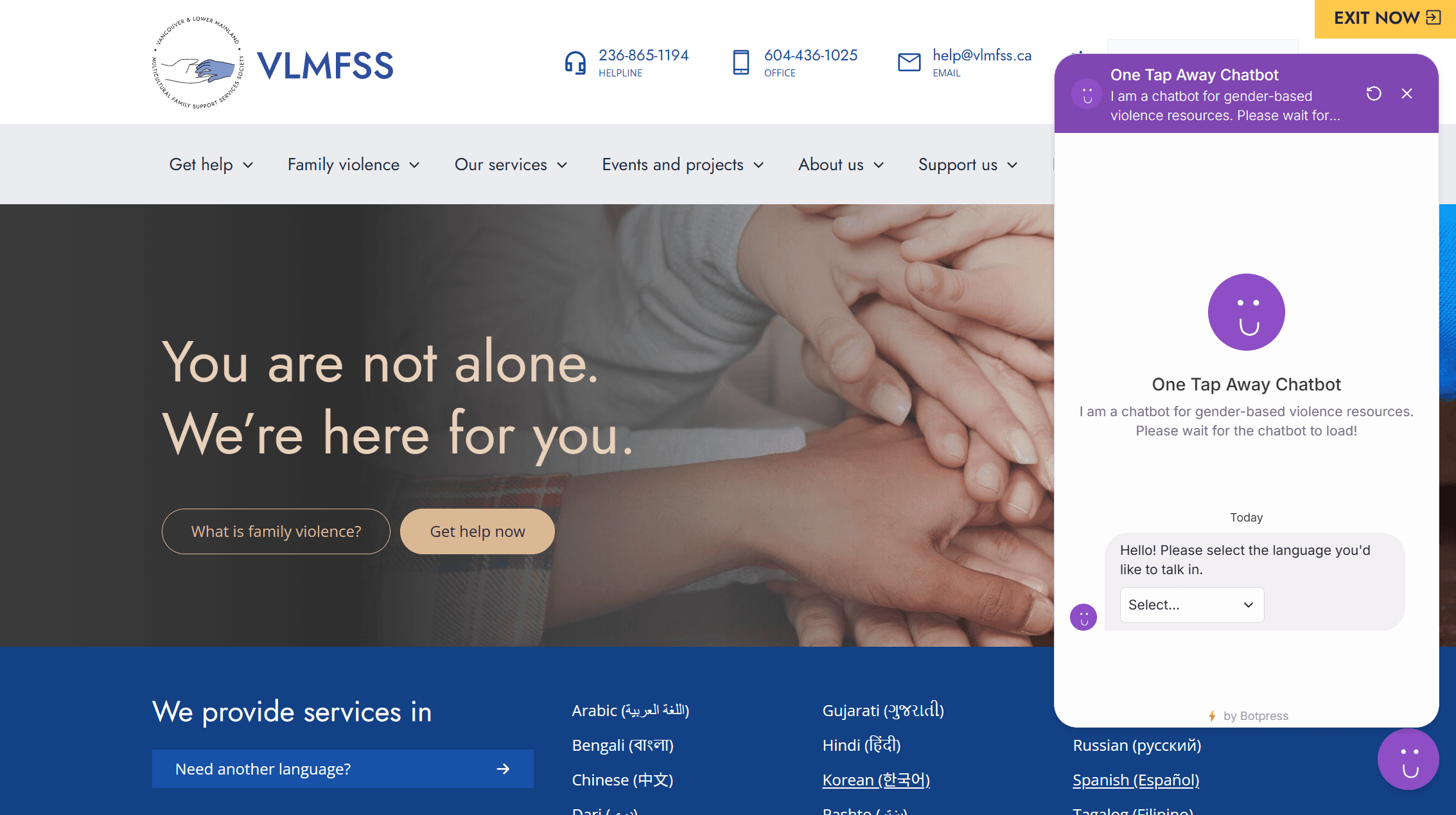
Rather than generating responses, the chatbot now directly retrieves information from the spreadsheet used as the knowledge base for the code-based chatbot, then structure it in a collapsible panel format.
As the next step, I plan to make my code-based chatbot available as a widget. As the widget is available, I will re-contact VLMFSS and see the possibility of replacing the Botpress version with it. In this way, I will have much clearer understanding of the chatbot mechanism.
In December 2025, CityStudio Vancouver hosted HUBBUB, a showcase where students can share their innovative projects to make the city of Vancouver more sustainable, equitable, joyful, and inclusive.
In this event, I had the opportunity to network and make meaningful connections with people at CityStudio Vancouver, who encouraged me to further the One Tap Away as an entrepreneurial project. Following the advice, I plan to explore some programs at SFU Charles Chang Institute for Entrepreneurship to grow this idea into a venture.
What did I reflect on as a result of this project?
One Tap Away project allowed me not only to apply our technical learning about RAG to real scenarios, but to challenge conventional methods of resource provision. Traditionally, resource provision is done by a human member within support network informing about relevant services. However, I saw the potential of evolving technology, such as generative AI acting as a non-human agent for such sensitive topics as gender-based violence support.
It is now much beyond an academic project for me; it is a medium for me to experiment with AI and make an impact on the social services industry that I am passionate about.